
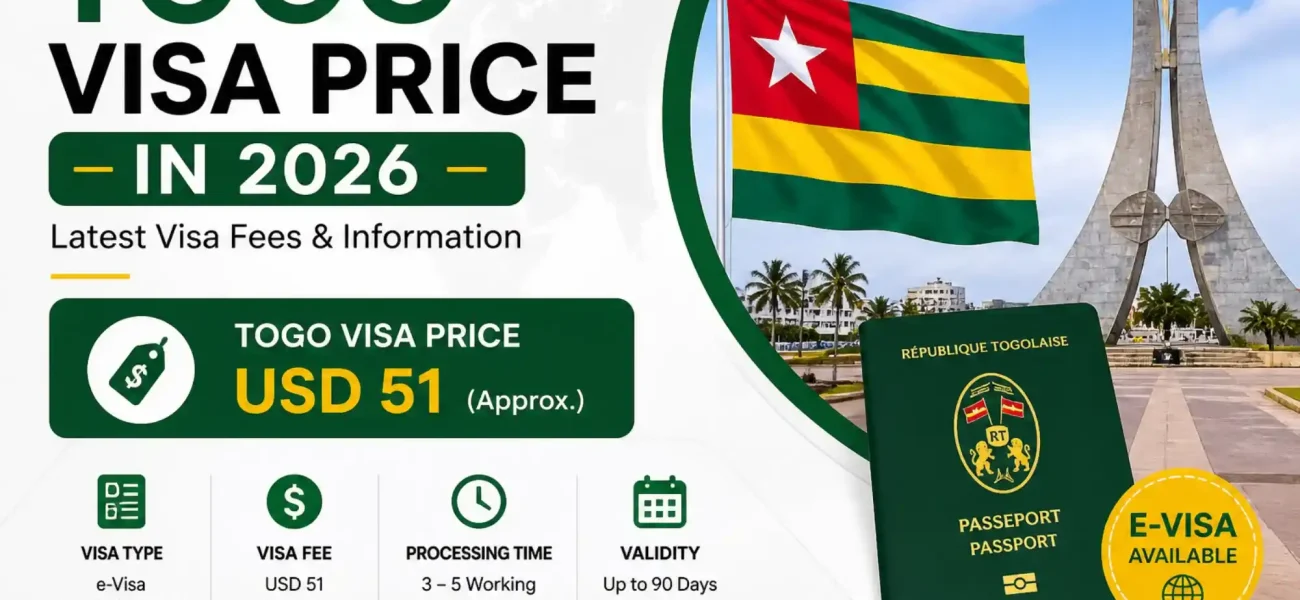
Togo is one of West Africa’s most underrated destinations — a narrow strip of a country with a surprisingly rich mix of coastal towns, forest reserves, traditional markets, and one of the region’s most vibrant capitals in Lomé. For international travelers planning a visit in 2026, the good news is that Togo has one of Africa’s most straightforward visa systems, built largely around a digital e-visa platform that has simplified the process considerably. The less obvious news is that the full cost of entry goes beyond the headline fee, and understanding the complete picture helps you budget properly.
Togo’s Entry System in 2026: What Has Changed
Togo introduced its e-visa platform several years ago as part of a deliberate push to attract more international visitors and business travelers. The system has matured considerably and is now the primary recommended entry route for most nationalities. In 2026, the platform continues to operate through Togo’s official immigration portal, accepting applications from travelers worldwide with processing typically completed within three to seven business days.
What makes Togo’s system notably traveler-friendly is its universal availability — unlike some African nations that restrict e-visa access to certain passport holders, Togo’s platform is open to almost all nationalities. The exception, as with most countries, applies to citizens of ECOWAS (Economic Community of West African States) member nations, who enter Togo visa-free and without charge.
Togo Visa Price Table 2026
The table below covers all current entry authorization categories available to international travelers in 2026. Fees are listed in USD, which is the standard collection currency for Togo’s online visa portal.
| Visa Category | Entry Type | Stay Permitted | Validity | Fee (USD) | Processing |
|---|---|---|---|---|---|
| Tourist E-Visa Recommended | Single Entry | 30 days | 90 days from issue | $50 | 3–7 business days |
| Tourist E-Visa — Extended | Single Entry | 60 days | 90 days from issue | $75 | 3–7 business days |
| Business E-Visa | Single Entry | 30 days | 90 days from issue | $50 | 3–7 business days |
| Business E-Visa — Multi Entry Popular | Multiple Entry | 30 days per entry | 90 days from issue | $100 | 5–10 business days |
| Visa on Arrival (Tourist) | Single Entry | 7–30 days | Issued on arrival | $50 – $80 | On arrival |
| Transit Authorization | Transit only | Up to 72 hours | Single use | $20 – $30 | 24–48 hours |
| ECOWAS Citizens | Free movement | Up to 90 days | Passport validity | Free | No application needed |
| Diplomatic / Official Passport | Varies by agreement | Varies | Varies | Exempt | Through embassy |
Breaking Down the Real Cost: What You Actually Pay
The government visa fee is the most visible cost, but experienced travelers know it rarely tells the whole story. Here is what the total outlay typically looks like for a standard tourist trip to Togo in 2026:
Yellow Fever: The Non-Negotiable Additional Cost
Togo requires proof of yellow fever vaccination from all arriving travelers, regardless of nationality or origin country. This is enforced at the border, and travelers without a valid International Certificate of Vaccination (the yellow card, officially known as the Carte Jaune) can be denied entry or vaccinated on the spot at a cost and under conditions that are far from ideal.

If you are traveling from a country where yellow fever vaccination is not routinely available through public health services, you will need to visit a certified travel health clinic. The cost varies significantly by country — in the UK and US it typically runs between $80 and $150 including the consultation. In many Asian and Middle Eastern countries it is considerably cheaper. Budget for this separately from your visa fee.
For travelers planning a West Africa itinerary that includes multiple countries, it is worth researching airline pricing from major regional hubs to understand how routing affects your total travel cost when combining Togo with neighboring destinations.
How to Apply for the Togo E-Visa
The application process is handled through Togo’s official online immigration platform. The steps are straightforward, but there are a few practical points worth knowing before you begin.
- Passport validity: Your passport must be valid for at least six months beyond your planned date of departure from Togo.
- Digital photo: A recent passport-sized photograph meeting biometric standards is required as part of the upload. Most online services that resize photos to meet official spec charge $3 to $8.
- Flight confirmation: You will need to upload a confirmed return or onward ticket. An unconfirmed itinerary or screenshot is generally not accepted.
- Accommodation proof: A hotel booking confirmation or invitation letter from a host in Togo is required for the application.
- Payment: The portal accepts international Visa and Mastercard. Some applicants from countries with restricted card access use a trusted third party for payment facilitation.
- Approval document: Once approved, you receive a PDF approval letter by email. Print this and carry it to the airport — it is presented to the airline at check-in and to immigration on arrival.
[Insert relevant reference link here]
Visa Extension: What Happens If You Need More Time
A standard tourist e-visa grants 30 days of stay. If your plans change and you need to remain in Togo beyond this period, extensions are possible but must be arranged in person at the Direction Générale de la Documentation Nationale (DGDN) in Lomé before your current authorization expires.
Extensions are not guaranteed and are granted at the discretion of the immigration officer. The fee for an extension typically falls in the range of 15,000 to 30,000 West African CFA francs — roughly $25 to $50 at current exchange rates. Overstaying without an approved extension results in fines at departure, the amount of which depends on the duration of overstay.
E-Visa vs. Visa on Arrival: A Direct Comparison
Togo E-Visa (Online)
- Fixed fee: $50 (tourist, 30 days)
- Applied from home before travel
- Processed in 3–7 business days
- PDF approval — no physical stamp needed pre-arrival
- Accepted by airlines for boarding
- Less stressful arrival experience
- Recommended for all travelers
Visa on Arrival (Lomé Airport)
- Fee: $50–$80 (variable, cash-dependent)
- No advance application required
- Issued immediately on arrival
- Cash in USD, EUR, or CFA typically required
- Queue times at peak hours can be long
- Stay granted may be shorter (7–14 days)
- Less predictable overall experience
The comparison makes a clear case for the e-visa route. Not only is it typically cheaper, but it removes uncertainty from the arrival process entirely — a meaningful advantage when you have connecting transport or accommodation waiting.
Nationalities That Enter Togo Visa-Free
Citizens of all 15 ECOWAS member states enter Togo without a visa and without any fee, using their national identity cards or passports. These countries include Nigeria, Ghana, Senegal, Côte d’Ivoire, Benin, Niger, Mali, Burkina Faso, Guinea, Sierra Leone, Liberia, Guinea-Bissau, The Gambia, Cape Verde, and Mauritania. Beyond ECOWAS, a small number of bilateral agreements exist — travelers should verify their specific nationality status before assuming exemption.
For travelers who enjoy combining cultural experiences with outdoor exploration during their West Africa trip, planning activities around destinations like Togo’s Kpalimé region offers excellent opportunities, and resources covering hiking and adventure travel destinations can help you map out the active parts of your itinerary.
Practical Tips to Avoid Common Mistakes
Apply Well in Advance
Although the stated processing window is three to seven business days, application volumes can cause delays during peak travel periods. Submitting your application at least two weeks before your departure date gives you a comfortable buffer without needing to pay for any expedited processing through a third-party agency.
Carry USD or EUR in Cash
Even with an approved e-visa, having small denomination USD or EUR in cash is advisable when traveling to Togo. Some fees — particularly for minor administrative services, local transport arrangements, or unexpected requirements at border crossings — are cash-based and not accessible through cards.
Verify Health Requirements Regularly
Beyond yellow fever, Togo may require additional health documentation depending on current regional health alerts. Check with your country’s travel health advisory service within 30 days of departure, as requirements can shift with limited notice.
Travelers who are researching hotel and accommodation costs alongside their visa planning will find that comparing hotel price guides across destinations is a useful way to build a complete trip budget rather than approaching costs in isolation.
Planning Your Togo Trip: Final Cost Summary
Togo’s visa system is genuinely one of the more accessible in West Africa — the e-visa is affordable, the process is digital, and the turnaround is reasonable. At $50 for a standard tourist e-visa, the headline cost is competitive with similar destinations in the region. But a realistic total entry budget for most travelers — accounting for the e-visa fee, yellow fever vaccination, travel insurance, and documentation costs — sits closer to $130 to $250 before you factor in flights and accommodation.
The key takeaway for 2026 travelers is simple: use the e-visa platform, apply early, and bring proof of your yellow fever vaccination without exception. Togo rewards travelers who prepare properly with a smooth, genuinely interesting experience that most West Africa itineraries benefit greatly from including.